Rebel leader, 56 inmates escape from East Timorese jail
Posted by
,
No Comments
Wednesday, August 30, 2006
East Timorese rebel leader Alfredo Reinado and other 56 inmates escaped last night from Dili‘s mail jail.
Australian and Portuguese forces initiated a massive manhunt for the escapees, which with their escape, created a new crisis for international security forces in East Timor. Australian SAS troopers using Black Hawk helicopters and night-vision goggles were involved in the search.
GNR‘s liaison officer, Lieutenant Cabrita told the Portuguese Rádio Renascença news agency that the prisoners took advantage of the relieve of guard to escape. “The evasion happened during the relieve of the forces that were serving in the jail’s security, having the escapees used vehicles for their escape”.
Later Australian police liaison officers confirmed the escape of the rebel leader. “It is understood 57 prisoners are currently unaccounted for, one of those being Mr Alfredo Reinado,” an Australian police spokesman said.
Alfredo Reinado is a former East Timorese Army officer who deserted and led a rebel group during the unrest in May, being blamed for some of the country’s violence during the security crisis.Him and other 14 soldiers of his rebel group were arrested on July by Australian troops for illegal possession of firearms after an GNR patrol found them with pistols, hundreds of ammunition and grenades in a house during a routine operation.
Of the other 56 prisoners unaccounted for, 16 are believed to be former Timorese police and soldiers accused of crimes committed during East Timor’s security crisis, and five prisoners convicted for homicide.
According to Becora’s prison warden Carlos Sarmento, the inmates had escaped by breaking down several walls on the prison’s east wing.
The East Timorese Justice Minister, Domingos Sarmento, blamed the international security forces for the jailbreak and told the Lusa news agency that the New Zealand forces in charge of the security of the prison’s exterior left the prison without informing the Timorese government.
“There was an agreement in which the forces of New Zealand would be in charge of the outside security of the prison, but about a week ago they left the location and didn’t inform us”, Domingos Sarmento said.
Domingos Sarmento said that he contacted the Australian-led forces so that the security outside the prison could be restored, but was told that the forces’ removal from the prison were due to the necessity of deploying troops in other points of the city.
The Minister recognized that the absence of police and military forces on the prison’s outside and the fact that the guard were unarmed contributed to facilitate the escape of the prisoners. Also recognizing that the use of weapons by the guards would improve the security in the jail, he noticed that the internal regulation doesn’t allow that use.
18 December 2004
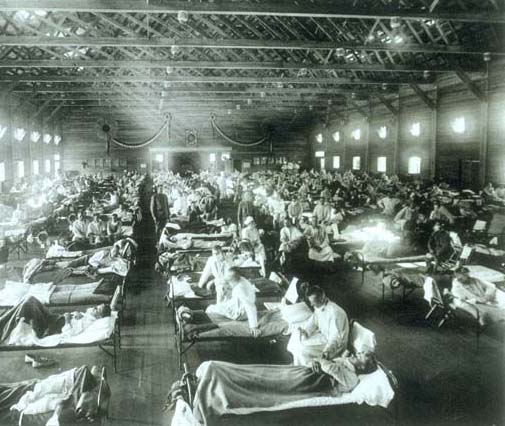
Emergency hospital during 1918 influenza epidemic, Camp Funston, Kansas (source: National Museum of Health and Medicine, AFIP).
A bout of the flu can be mild. In young, healthy adults, many infections pass unnoticed. But sometimes the influenza virus evolves into a strain that decimates its victims. The worst known strain swept the world in the Fall of 1918, infecting 500-1000 million and killing 40-100 million, about 2-5% of people.
There are several theories about where the pandemic began, but the likeliest origin was in Haskell County, Kansas, in the United States. People in the sparsely populated county, where farmers raised pigs, poultry, cattle, and grain, began suffering from influenza in late January 1918. Unusually for flu, it was young, healthy adults who were hardest hit. Victims fell ill suddenly, many progressing to pneumonia and dying, often within days. Within weeks, however, the epidemic ended. The natural geographic isolation of this community normally might have contained the fatal flu in a sort of unintentional quarantine, but the First World War intervened. Men were uprooted from their home towns and congregated in huge numbers in army camps for training and then shipping out to other camps or to fight in Europe. The destination for men from Haskell County was Camp Funston, part of Fort Riley, Kansas, where the first influenza case was reported in early March. As soldiers moved among camps, the virus spread. Within two months, the epidemic spread to most of the army camps and most of the largest cities in the United States. As American soldiers went to France, so did the virus, spreading first from the port of Brest.
The flu then spread worldwide. The pandemic reached its height in the Fall of 1918. Spain was affected early, and because Spain was not fighting in the World War, there was no wartime censorship, and news of the outbreak became widely known, leading to the flu being called the Spanish Flu in many countries. In Spain, however, it was called French Flu or the Naples Soldier. In India, about 12 million people died of flu. In some US cities, people died so quickly that morticians couldn’t cope with the bodies. According to Jessie Lee Brown Foveaux, who worked in the Fort Riley laundry during the epidemic: “They were piling them up in a warehouse until they could get coffins for them.”
The disease started with cough, then headache. Temperature, breathing and heart rate increased rapidly. In the worst cases, pneumonia came next, the lungs filling with liquid, drowning the patients and turning them blue from lack of air. Patients bled from every orifice: mouths, noses, ears, eyes. Those who survived often suffered temporary or permanent brain damage. Several million developed encephalitis lethargica, in which victims were trapped in a permanent sleeplike and rigid state, as portrayed in the 1990 movie “Awakenings.” In others, normal thought processes were impaired. During negotiations to end World War I, US President Woodrow Wilson was struck with flu, and people around him noted that his mental abilities never fully recovered. The French leader George Clemenceau had wanted harsher punishment of Germany than Wilson had desired. Clemenceau may have convinced Wilson in his weakened state to accept such harsh terms, which may have been one of the factors causing World War II.
Since flu is highly contagious early in the illness, even before symptoms appear, strict quarantine may be necessary to stop its spread during an epidemic. Australia kept its 1918 flu death rate relatively low by enforcing quarantines. However, in many parts of the world, public health officials hesitated to impose such measures, giving the disease time to gain a foothold. In the US city of Philadelphia, a rally of half a million people was planned in September 1918 to sell bonds to fund the war, at just the time when the flu started to infect residents. Although doctors warned the public health director to cancel the rally, he wanted to meet the city’s quota to raise money for the war and refused to cancel the event. Within days after the rally, half a million city residents caught the flu.
Why was the 1918 flu so deadly? The influenza virus wasn’t preserved at the time of the outbreak, at least on purpose. But in the late 1990s researchers Ann Reid, Jeffery K. Taubenberger, and their colleagues extracted and sequenced the genetic material of the virus, RNA, from tissue of victims who died in the pandemic. They used bits of lung that were preserved in formalin from victims on army bases or from victims buried in permafrost in the Alaskan village of Brevig Mission, where flu killed 85% of adults. Comparisons with known flu viruses in humans, pigs, and birds suggest that some genes of the 1918 virus came from birds or an unknown animal source. Other scientists then were able to show that the amino acid sequence of hemagglutinin protein from the 1918 virus had several changes from other flu viruses that may have helped it to easily bind and invade human cells, and that made the virus look different enough from earlier flu virus strains that people had no immunity.
The possibility exists that another flu pandemic will sweep the world like the one in 1918. In 2004, an H5N1 influenza virus has killed millions of birds and at least 30 people in southeast Asia. So far this virus strain has not evolved the ability to pass directly from human to human, but that possibility becomes more likely as the bird flu pandemic continues and humans remain in contact with chickens, ducks, and other birds. The virus has killed two-thirds of people reported to be infected. Dr. Tim Uyeki, an epidemiologist for the US Centers for Disease Control, says, “you have the ingredients in Asia right now for a public health disaster.”
But since sequences of this bird flu virus are known, it may be possible to develop a vaccine or set of vaccines to protect against it. At a special meeting of influenza experts on November 11th and 12th, World Health Organization influenza program chief Klaus Stohr said, “It is not only possible, but also important, that influenza pandemic vaccines be made available… and there’s a shared responsibility needed to make that happen…. We have a huge window of opportunity now.”
Wednesday, May 9, 2007
An Afghan doctor, Rahmatullah Hanefi, who works for the Italian non-governmental organization (NGO), Emergency, will go on trial in Afghanistan for his alleged role in the March, 2007 slaying of Afghan interpreter and reporter, Adjmal Nashbandi.
Italian journalist, Daniele Mastrogiacomo, his driver and interpreter were kidnapped by the Taliban in Helmond Province, Afghanistan on March 5, 2007. During the ensuing negotiations for Mastrogiacomo’s release, his driver, Sayed Agha, was killed by their Taliban captors. Mastrogiacomo’s interpreter, Adjmal Nashbandi, was later executed by the Taliban. The release of Mastrogiacomo was controversial and criticized at the time for the exchange of five Taliban prisoners in return. Hanefi mediated negotiations, reportedly, with the Taliban for the release of Mastrogiacomo.
Afghanistan’s ambassador in Rome said Tuesday that Hanefi would be put on trial “soon”. It was not revealed what the specific charges against Hanefi are, but it has been suggested that the offence may be accessory to murder in the death of Nashbandi. “Hanefi’s case will come to trial soon, maybe in a week, and a lawyer will be nominated to assist him,” said Musa Maroufi, Afghanistan’s ambassador to Italy. He added that “no execution will be carried out” against Hanefi.
In April, Emergency closed the three hospitals it operates in Afghanistan. The NGO has denied that Hanefi had anything to do with Nashbandi’s death. In a news update on its U.S. website Monday, Emergency suggested that their international staff were forcibly removed from the hospitals by Afghan authorities.
“Continuing under a pretense of normalcy in this situation would provide services so inadequate as to endanger our patients,” said Emergency in the news update. They have decided “to suspend all activity until conditions allowed for the return of… international staff” and suggested a clarification was required from the Afghan government “concerning intimidating threats” allegedly made by the government.
Emergency is pressing for the release of Hanefi.
December
5
Update since publication
This article mentions that Wi-Fi stands for “Wireless Fidelity”, although this is disputed.
Thursday, July 7, 2005
A Florida man is being charged with 3rd degree felony for logging into a private Wi-Fi (Wireless Fidelity) Internet access point without permission. Benjamin Smith III, 41, is set for a pre-trial hearing this month in the first case of its kind in the United States.
This kind of activity occurs frequently, but often goes undetected by the owners of these wireless access points (WAPs). Unauthorized users range from casual Web browsers, to users sending e-mails, to users involved in pornography or even illegal endeavours.
According to Richard Dinon, owner of the WAP Smith allegedly broke into, Smith was using a laptop in an automobile while parked outside Dinon’s residence.
There are many steps an owner of one of these access points can take to secure them from outside users. Dinon reportedly knew how to take these steps, but had not bothered because his “neighbors are older.”

See More About:
By Patricia Holland
A toilet enclosure is created by installing two toilet partitions around either side of the toilet and sealing off the compartment with a hinged door. This very basic design can then be expanded and customized to any restroom interior. Thanks to the range of options in colors, materials used to make partitions, and the many ways to install partitions, contractors can create private space for any restroom user without wasting space, time, or money in the process.
A toilet enclosure can be built out of partitions made from several different types of materials. On our site, you will find choices in baked enamel steel, stainless steel, plastic laminate, solid Phenolic, and Bradleys proprietary Bradmar solid plastic. Solid plastic is by far the most resilient of surfaces. It is made from a contiguous, colored piece of plastic that does not require painting or repainting. It is vandal resistant and completely moisture resistant, making it the easiest of all materials to clean. It is admittedly, however, the most expensive of the five choices.
When cost is a major determining factor in bidding a contract, it may be necessary to consider alternatives to solid plastic. Baked enameled steel is the most affordable of these alternatives. It has proven itself to be more than adequate in applications ranging from church restroom design to franchise restaurant design. While it ranks rather low in vandal resistance, a baked enamel toilet enclosure will remain in good condition for years in any environment with low traffic or moderate traffic with minimal risk of abuse. Plastic laminate is a bit more expensive but it is also more durable. It can handle heavier traffic, and the plastic outer coating is easy to clean. Stainless steel is standard in the medical care industry, as well as some restaurants and factory restrooms. Stainless steel is a fine, attractive material that is highly durable, moisture resistant, and super hygienic.
Partitions further vary according to the way they are mounted. This pertains specifically to how the dividers are installed to create a toilet enclosure. Restroom dividers can be mounted to the floor, hung from the ceiling, mounted to both the floor and ceiling, or they can be mounted to the floor and braced with a head rail attached to the rear wall. These four configuration options allow contractors to create restroom floor plans in any size room. The depth of a concrete floor, the height of the ceiling, and the amount of clearance necessary in and around partitions are all factors that play a role in how stalls can be designed within existing space. Bradley restroom partitions are among the finest in the world, if not the very finest in the world, when it comes to giving contractors more opportunities to adapt restroom stall design to the actual space they have available without compromising the integrity of the design.
Based on this, and on the availability of a number of partition components and accessories that are used to create a toilet enclosure, a restroom stall can be designed for ADA compliance, complete site free privacy, and full open floor access to cleaning crews. The size of the stall can be customized to single user, two-user, or large multi-user configurations. Stalls can be placed in restrooms with built-in showers, lockers, and wash fountains, or they can be standalone privacy compartments for the very smallest of possible spaces.
About the Author:
XPB Locker
. Read more about
toilet enclosure.commercial bathroom partitions.phenolic core toilet partitions.
Source:
isnare.com
Permanent Link:
isnare.com/?aid=1259495&ca=Home+Management
December
4
Update since publication
This article mentions that Wi-Fi stands for “Wireless Fidelity”, although this is disputed.
Thursday, July 7, 2005
A Florida man is being charged with 3rd degree felony for logging into a private Wi-Fi (Wireless Fidelity) Internet access point without permission. Benjamin Smith III, 41, is set for a pre-trial hearing this month in the first case of its kind in the United States.
This kind of activity occurs frequently, but often goes undetected by the owners of these wireless access points (WAPs). Unauthorized users range from casual Web browsers, to users sending e-mails, to users involved in pornography or even illegal endeavours.
According to Richard Dinon, owner of the WAP Smith allegedly broke into, Smith was using a laptop in an automobile while parked outside Dinon’s residence.
There are many steps an owner of one of these access points can take to secure them from outside users. Dinon reportedly knew how to take these steps, but had not bothered because his “neighbors are older.”
Friday, April 20, 2007
For the past week, approximately 100 sealing ships have been trapped in ice floes off the northeast coast of Newfoundland. The ships and their crew had been participating in the annual seal hunt off Canada’s easternmost province.
Several of the vessels have been damaged by the ice and supplies are now running low for those sailors awaiting rescue by the Canadian Coast Guard. As of Thursday, 6:00 p.m. EDST, some 20 crew members, out of an estimated 400, had been rescued.
A Coast Guard icebreaker, the Sir Wilfred Grenfell, on mission to free the trapped ships, itself became stuck in the ice. A Department of Fisheries and Oceans (DFO) spokesperson indicated to CTV News that, although the Grenfell had since been freed, another icebreaker, the Ann Harvey, was now trapped. “It’s just such heavy ice that even ice breakers are having trouble,” said Erika Pittman, a communications officer with the DFO.
In addition to the crushing ice, extreme weather conditions have been hampering rescue efforts. Pittman suggested that conditions wouldn’t improve until sometime next week. The amount and thickness of the pack ice, according to Pittman, is the worst it has been for sealers in the past 15 years.
In addition to three icebreakers on hand, the Coast Guard is flying helicopters in to provide food and support to the stranded sailors. Most of the sealing ship captains have refused to abandon their ships, instead staying with them and hoping for a change in conditions or to be freed by the Coast Guard.
“Usually you try to stay with the ship because you think the safety is with the ship because the ship is big, but sometimes it is too late. In this case, we’re hoping that as it changes and the breakers and helicopters are there and we can get them all out,” said Brian Penney, a superintendent with the Coast Guard.
“They’re putting a lot of effort into pulling them out,” said Penny. “But the sheer numbers, it’s a very, very slow process.” According to Penny, approximately 15 of the longliners ships have had their hulls damaged by the ice to the extent that the ships are at risk of sinking.
Critics of the seal hunt point out that the annual hunt is not only “cruel to animals”, but is also a dangerous occupation for the sealers. When sealers have to be rescued by the Coast Guard, “Canadian taxpayers foot the bill,” suggested Rebecca Aldworth, director of Canadian wildlife issues for the Humane Society of the United States.
Sunday, March 20, 2005
KYUSHU, Japan –
A powerful magnitude 7 earthquake rocked Japan’s southwestern island of Kyushu at 10:53 am local time today (0153 UTC), prompting the Japanese Meteorological Agency to issue tsunami warnings for the area. The tsunami warnings were canceled later in the day.
A 75-year-old woman was killed in Fukuoka city by a falling wall. At least 400 people were injured by the quake. Local Fukuoka Airport and high speed bullet trains in the area temporarily suspended operations to look for damage.
According to the agency, the epicenter of the earthquake was in shallow water in the Sea of Japan, off the north coast of Fukuoka Prefecture.
Small aftershocks continued throughout the day, with authorities advising that residents should be prepared for aftershocks of up to magnitude 6.
In the aftermath of the quake, people were quickly alerted to the state of the situation by television reports, telephone, and text-messaging systems.
Interviewed by telephone in Hitoyoshi, well inland from the epicenter of the quake, a local resident noted the severity of the quake was frightening, and left the elderly woman unable to remain seated on a chair. Shutting off gas was the first priority, with the local television coverage providing a quick status update for the situation, followed by an interruption by national emergency network coverage.
A foreign resident of Fukuoka city reported taking refuge under his desk for several minutes as books and ornaments fell from shelves. He prepared to evacuate to high ground in case of a tsunami, but news reports indicated little danger from a tsunami. He also reported that Japanese residents appeared unconcerned by the quake, with many strolling near Momochi beach shortly after the quake, showing little apparent concern.
In Tenjin, downtown Fukuoka, Fukuoka Building’s windows shattered, and the block was quickly cordoned off. In addition to Fukuoka Building, many other buildings and businesses remained closed to shoppers.
Wikinews contributor Oarih reports that a festive atmosphere pervaded the streets, however, as employees from Nishinihon Shimbun (a major Japanese newspaper) passed out one-page articles on the earthquake and curious onlookers investigated the damaged buildings and sidewalks. Many residents, relieved by the relatively low damage inflicted by the earthquake, started visiting pubs and restaurants at lunch for a celebratory beer. With train and subway services disrupted, queues over 100 people long formed at some Nishitetsu bus stops in Tenjin as dusk approached.
The penetration of modern text-messaging by the Japanese Keitai, the common Japanese cell phone system more prevalent than computer-based email, led to quick status checks on many family members located near the coast around Fukuoka, close to the quake’s epicentre. Wikinews contributor Oarih reports that cell phone service providers were swamped by the spike in use, however, and both voice and text services remained unreliable for much of the day.
Tuesday, April 10, 2018
On Saturday, the Trump Tower, in Midtown, New York City, caught fire shortly before 18:00 EST (2200 UTC) on the 50th floor, claiming the life of a 67-year-old resident, Todd Brassner, who lived in apartment 50C. All other residents were evacuated without incident. During the fire, six firefighters received non-life-threatening burns and other minor injuries. Neither US President Donald Trump nor the First Family were in the building at the time of the fire.
The high-end Fifth Avenue address is the personal residence of President Donald Trump, whose family occupies the top three stories of the 58-story building. The US Secret Service maintains a constant security presence inside the building with the New York City Police Department guarding a hard perimeter, intended to stop vehicular attacks, and a soft perimeter, intended for on-foot attacks.
The four-alarm fire required 200 firemen, extra police, and paramedics. At 20:00 EST (0000 UTC Sunday), the New York City Fire Department (FDNY) declared the fire was under control. Trump tweeted, “Firemen (and women) did a great job. THANK YOU!” This is the second fire at Trump Tower since the election; previously on January 8, a fire was caused by an electrical malfunction in a cooling tower on the roof. Three FDNY firefighters received minor injuries, and all residents and office workers evacuated without incident on that occasion.
Trump Tower provides a number of unique problems never before encountered by the Secret Service. Never has a US President’s personal residence been inside a skyscraper or in a densely populated area like Midtown. The security measures have disrupted vehicular and pedestrian traffic requiring time consuming detours and delaying emergency response.
The New York Fire Code did not mandate sprinkler systems at the time Trump Tower was built in 1983, which might have reduced the size and severity of the fire had they been present. The 50th-floor apartment was, according to FDNY Fire Commissioner Daniel Nigro, “[T]he apartment was virtually, entirely on fire.” The Secret Service monitors all the fire alarms in the building but it took time to find the source of the thick black smoke emanating from the fire. Secret Service Agents escorted the firefighters throughout the building, including the Trump residence.
Brassner, the sole casualty, was unconscious when firefighters pulled him out of apartment 50C. He was transported to Mount Sinai Roosevelt Hospital. Originally listed as critical, he was pronounced dead sometime during the night. Brassner, guitar collector, was acquainted with artist Andy Warhol and was acknowledged in Warhol’s 1989 autobiography, The Andy Warhol Diaries. The cause of the fire is unknown, with investigations into Brassner’s death and the emergency response ongoing. Currently, the Secret Service leads the investigation.
December
1
Tuesday, February 26, 2013
Yesterday evening in La Molina, Spain, Wikinews sat down and talked with Irene Villa to discuss para-alpine skiing, disability sport, women’s sport, and her own sporting career. Villa was in town as part of activities taking place around the 2013 IPC Alpine World Championships, where one of her skiing club teammates is competing as a member of the Spanish team. Her high profile in Spain has brought additional interest to para-alpine skiing and disability sport in general.
((Wikinews)) : Hi we are interviewing Irene Villa, who is a disability skier from Spain and professional author, social figure, journalist, and psychologist. You are most well known for being a terrorist survivor, but you’re here because of the [2013 Alpine Skiing] World Championships. ((es))Spanish language: ?Hola estamos entrevistando a Irene Villa, esquiadora española, escritora, figura política, psicóloga y periodista. Aunque se le conoce más por haber sobrevivido a un atentado, se encuentra aquí por el Campeonato del Mundo [de Esquí Adaptado 2013].
((WN)) : In 2009 you said you were trying to make the 2010 Winter Paralympics. After giving birth are you going to continue with the sport and hope to make 2018? ((es))Spanish language: ?En 2009 dijo que quería clasificarse para los Juegos Paralímpicos de Invierno de 2010. Tras dar a luz, ¿va a continuar con el deporte e intentar llegar a 2018?
((WN)) : You compete in a lot of national competitions, and with disability sport in general, classification is a big issue. Competing in national competitions, does classification come into play, especially when there is so few women skiers in your group? ((es))Spanish language: ?Participa en muchas competiciones nacionales, y en el deporte con discapacidad en general, las clasificaciones son un un tema polémico. En la competición nacional, ¿es la clasificación un factor tan determinante, especialmente cuando hay tan pocas esquiadoras en tu grupo?
((WN)) : Some of the skiers I’ve talked to in the mens’ side, not in Spain, but from other countries, have complained about the quality of womens’ skiing, and that there’s not enough high quality competition. That’s why I was interested in if classification was impacting women’s skiing because there is so few women skiers, that classes seem they’d make it harder to find competitors in classes that are making the sport equitable and fair. ((es))Spanish language: ?Algunos de los esquiadores de otros países con los que he hablado se quejaban de la calidad del esquí femenino, y la escasa calidad de la competición. Por eso me interesaba saber si la clasificación incidía en el esquí femenino al haber tan pocas esquiadoras, que las clases parece que hacen más dificil encontrar competidoras en clases que hacen el deporte más equitativo y justo.
((WN)) : Your personal experiences have adequately prepared you to hurl yourself down the mountain at high speed? ((es))Spanish language: ?¿Sus experiencias personales le han preparado adecuadamente para lanzarse pendiente abajo a máxima velocidad?
((WN)) : Most of the ski team looks like they come from the Madrid area? From the Fundación También? ((es))Spanish language: ?¿La mayor parte del equipo parece que vienen de Madrid? ¿De la Fundación También?
((WN)) : How does a Frenchwoman become a Spanish skier? ((es))Spanish language: ?¿Cómo se convierte una francesa en una esquiadora española?
((WN)) : So there’s a national ski culture. People think of Spain as a place with beaches and no snow. ((es))Spanish language: ?Así pues hay una cultura de esquí a nivel nacional. La gente piensa de España como un lugar con playas y nada de nieve.
((WN)) : The Paralympics in Spain are supported by the Plan ADO Paralímpico. Do they provide enough support to women and to winter sports in general? ((es))Spanish language: ?Los deportistas paralímpicos reciben apoyo gracias al Plan ADO Paralímpico. ¿Proporcionan suficiente apoyo para las mujeres y los deportes de invierno en general?
((WN)) : When I’ve read about disability skiing in Spain for women, they talk about you and they talk about Teresa Silva. Is there a way to get more attention for women skiers on that level, outside of using you and Teresa Silva as a vehicle? Not that you are not great for drawing attention! But how do you draw more attention to women’s sports and high quality that women are capable of doing? ((es))Spanish language: ?Cuando he leído sobre el esquí adaptado en España, suelen hablar de usted y Teresa Silva. ¿Existe alguna forma de atraer más atención a las esquiadoras, más allá de usarlas a ustedes como reclamo? ¡No es que no sean fantásticas para atraer atención! ¿Pero cómo se incrementa la atención al deporte femenino y a la alta calidad que las mujeres son capaces de lograr?
((WN)) : As an outsider from, not Spain, I know you are a political figure. Has that gotten in the way of your ability to be a sportswoman? ((es))Spanish language: ?Como alguien que no es de España, entiendo que usted es una figura política. ¿Ha sido eso un obstáculo a la hora de ser una deportista?
((WN)) : When all is said and done, what do you kind of want your legacy to be? Do you want to be known as Irene Villa, disability sport advocate figure? Do you want to be known like Jon Santacana, or do you want to be known as somebody who has pushed the boundaries in other areas? ((es))Spanish language: ?Al final del día, ¿qué clase de herencia desea dejar? ¿Ser conocida como Irene Villa, deportista y defensora del deporte discapacitado? ¿Ser conocida como Jon Santacana, o como alguien que ha forzado los límites en otras áreas?
((WN)) : Thank you very much! ((es))Spanish language: ?¡Muchísimas gracias!